The right crypto accounting platform should help your team complete the close, not only display a portfolio. A company needs to explain transactions, preserve acquisition costs, review balances and deliver records to its accounting system. An accounting firm needs that process for several clients, without mixing their data.
Conta Finance was built for this workflow, starting with Stakely’s internal needs. Its value is the connection between activity and accounting review. Here is how to evaluate that fit for your business, your group or your firm, using checks you can repeat in a demo.
For companies: one review process from source to close
Your treasury can use several wallets, exchange accounts and blockchains. The finance team still needs one understandable set of company records. Conta centralizes supported digital asset activity and lets you identify the company’s own accounts and counterparties before reviewing the transactions.
Internal transfers deserve particular attention. Moving assets between the company’s accounts is not automatically revenue or a disposal. The source, destination, fees and classification must remain understandable. Ask to inspect both sides of a real transfer instead of evaluating only the dashboard total.
For accounting firms: several clients, separate organizations
A firm’s challenge is not only transaction volume. It is knowing which person works on which client, which entity they can enter and which decisions need review. One client may have several companies; one accountant may work across them while another reviews only one.
Conta organizes records and access per organization. A common team can work across the entities it is authorized to enter. This does not imply legal consolidation or automatic intercompany eliminations. Evaluate the entity structure you need and the outputs your firm delivers to each client.
Automation that your accountant can inspect
Classification rules reduce repeated decisions for recurring activity. Historical prices and currency references support valuation. Acquisition-cost calculations help review realized gains and losses. These steps need consistent inputs: missing activity or a missing price cannot be solved by a persuasive report.
The team can investigate transactions, complete information and correct classifications before using the results. Test a complex operation such as a swap or a reward. Ask what rule applied, where the price came from and which lot explains the acquisition cost.
Reconciliation is more useful than a balance that only looks right
Conta compares calculated balances with available source balances to identify differences. This gives the team a place to investigate missing activity, inconsistent records and timing issues. A check is useful when the underlying reference can be examined, not when it simply decorates a report.
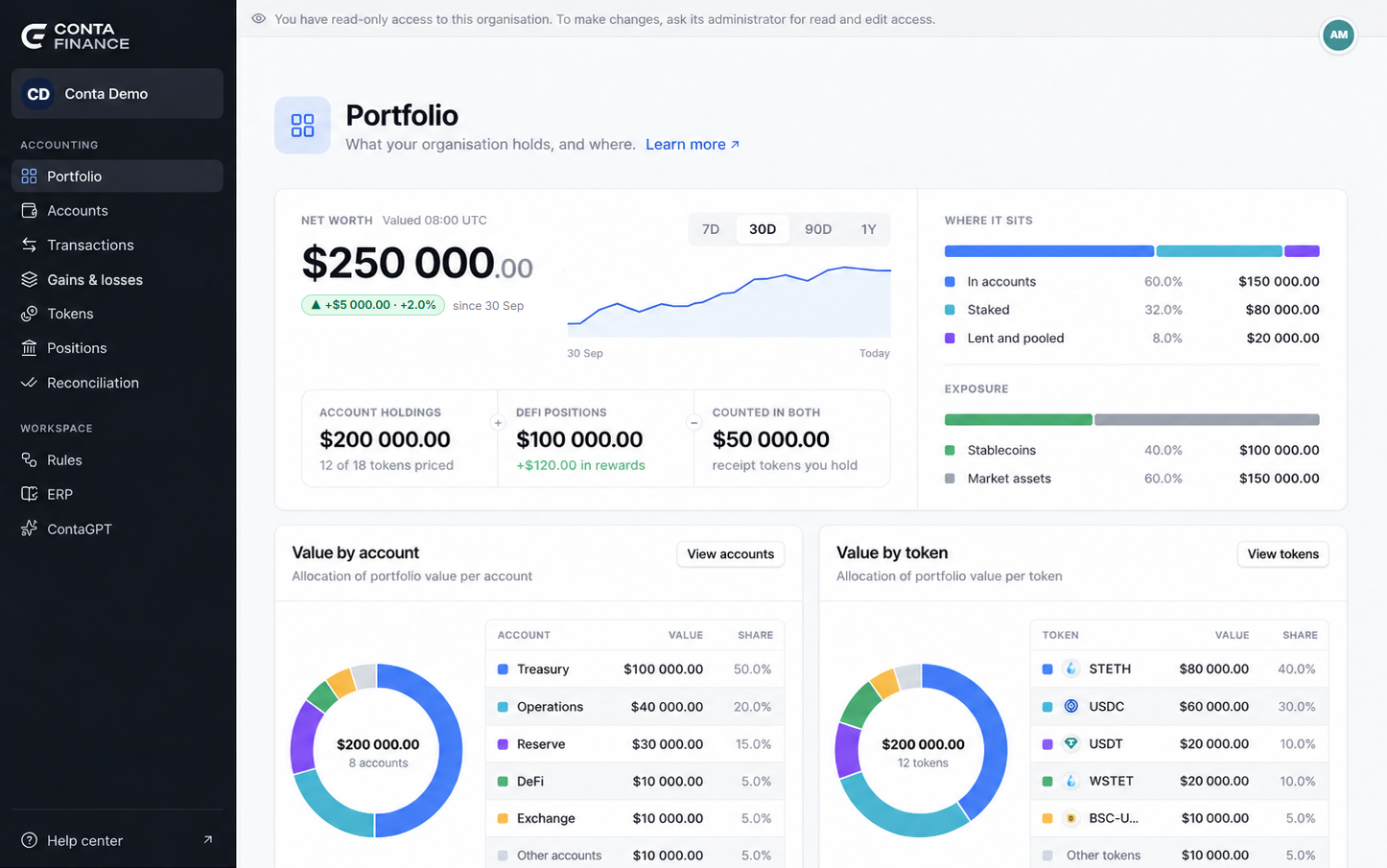
Keep a distinction between account holdings and DeFi positions. A position can represent assets already counted elsewhere. Adding every view together can double-count exposure. Conta’s positions support visibility; they do not automatically add new Ledger movements or acquisition costs.
The output must fit your accounting system
A product demonstration should end where your team actually works: in its reviewed export or ERP flow. Conta supports structured accounting outputs. Depending on the available connection, the process can use exports or synchronization. Do not assume every accounting system has the same native integration.
Bring your chart of accounts and a representative example. Check debit and credit mapping, fees, dates and the required format. Agree the available scope before buying. A familiar ERP logo is not proof that the exact workflow your firm needs is already implemented.
AI can help investigate without taking the final decision
ContaGPT works with the context available in the organization. It helps investigate records and can propose changes that a person confirms. The MCP connection exposes tools to a compatible external assistant, with the user’s permissions and the same confirmation boundary.
This is useful when the team needs an answer tied to actual records. It is not a substitute for an accountant’s judgment. Use the AI demonstration to test the source evidence and approval process, not only the speed or tone of an answer.
How to decide whether Conta is the right fit
The best platform for your team is the one that supports its actual close. Evaluate coverage, review effort, permissions and output together. Compare the same sample of activity across your shortlist. Ask for a proposal based on entities, users, volume and the connections you need.
- Can the team explain a reward, swap and internal transfer?
- Can a reviewer enter one entity without gaining access to all?
- Can the accountant use the exported records without rebuilding them?
- Are coverage gaps and unresolved differences visible before you commit?
Frequently asked questions
What is the best crypto accounting software for a business?
There is no universal winner. Compare the sources, operations, entity permissions and accounting outputs your team needs. Conta is designed for business review and multi-organization workflows; test that fit with representative data.
Can Conta replace our ERP?
Its role is to prepare and review digital asset activity for the accounting workflow. Your accounting system keeps its own role. Agree the export or synchronization scope for your system.
Is this only for businesses that hold crypto?
No. Accounting firms and on-chain businesses can also use it. Their evaluation should reflect their own service model, transactions and reporting responsibilities.