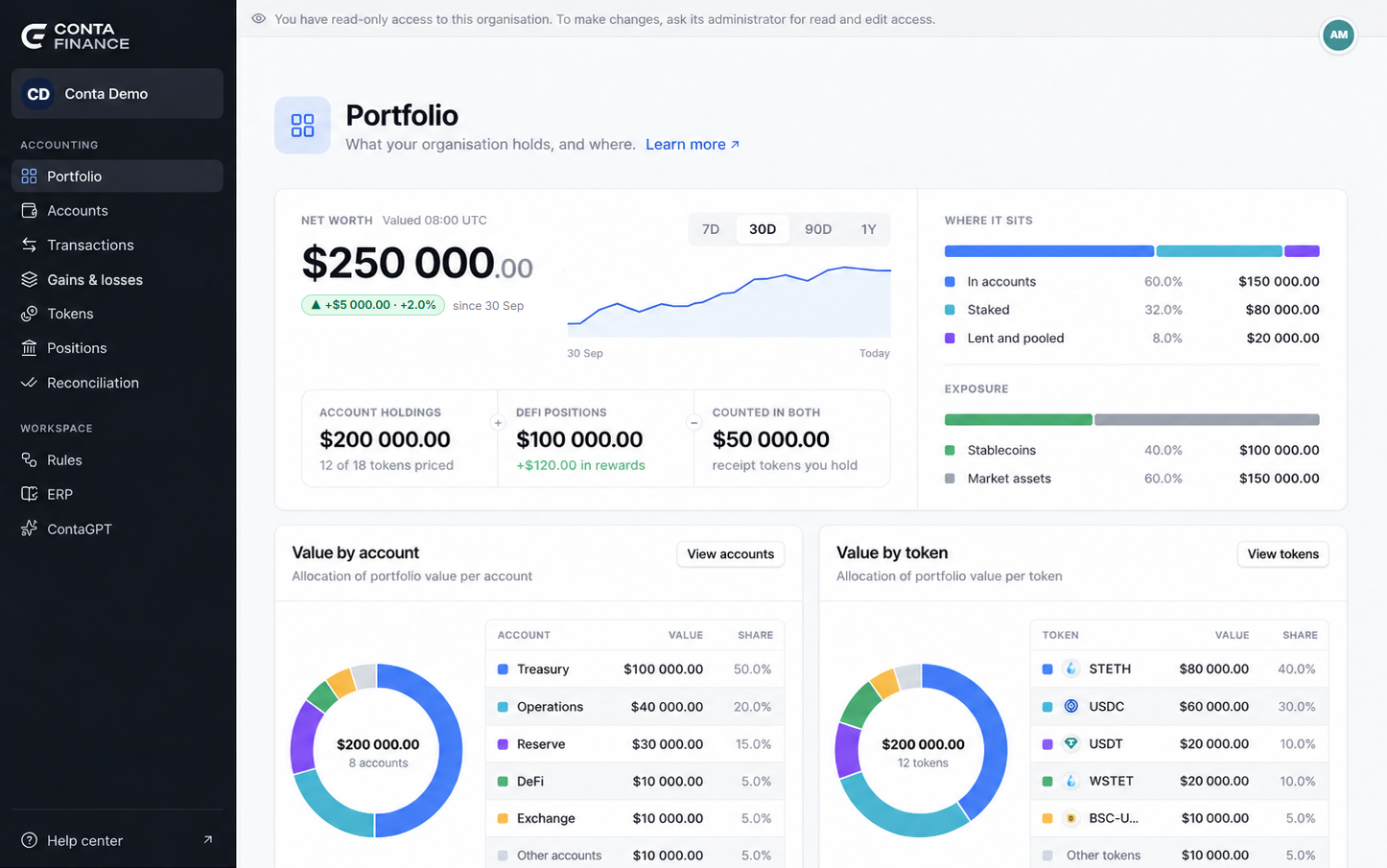
Stakely created Conta Finance because it needed the tool itself. Running blockchain infrastructure requires technical precision. Closing the accounts requires a different kind of precision: explain what the company earned, where its assets are and which records support each amount.
This is our origin story, not a testimonial from an external customer. Stakely has provided staking and blockchain infrastructure since 2020. In 2025, we began building an internal accounting tool. In 2026, we opened Conta Finance to other businesses and accounting firms, while continuing to use it ourselves.
The problem was inside our own finance workflow
The team knew how blockchains produce data. That did not remove the accounting work. Activity still had to be identified, interpreted, valued and assigned to the correct company. A transaction hash alone could not tell the accountant whether a receipt was a reward, a service fee or an internal transfer.
We combined accounting knowledge with the infrastructure experience we already had. The objective was not to create another staking dashboard. It was to connect operational records with a process the accounting team could review, correct and use at the close.
Delegated stake is not automatically the provider’s asset
A staking provider must distinguish its own positions from assets delegated by other people. It must also distinguish the validator’s commission from the rewards owed to delegators. A large amount displayed by an explorer does not establish ownership or revenue.
This distinction changes what belongs in the company’s accounting scope. Document the service, the beneficiary, the account and the relevant period before applying an accounting policy. Operating infrastructure, holding funds and earning fees are different activities.
A concrete question for the close
“Which receipts are this entity’s validator income, and which movements only move its existing assets?” The answer requires ownership and transaction context, not a single total.
Why staking income needs more than a transfer list
Blockchains do not all record rewards in the same way. Some activity appears as a transaction. Other balance changes come from protocol events or periodic credits. A missing transfer row is not enough to conclude that no reward exists.
For review, keep the asset quantity separate from its value in the reporting currency. Also separate rewards received from amounts still pending. The accounting team decides recognition based on the facts and applicable rules, not on a universal staking category.
- Identify the account, blockchain, asset and reward source.
- Keep the event date, quantity and historical price reference.
- Review fees, withdrawals and unexplained balance changes separately.
How this need becomes a workflow in Conta Finance
Conta brings activity from supported sources into an organization’s records. Named accounts and counterparties give transactions a business context. Classification rules help with recurring activity, while the team investigates exceptions instead of rebuilding every operation manually.
The next checks address valuation, acquisition costs and balances. Reconciliation compares recorded balances with the available source data. A difference remains a difference until it has an explanation; it should not be hidden with an adjustment simply to make a report look complete.
- Own accountsIdentify the entity and supported sources
- ClassificationSeparate rewards, fees and internal transfers
- ReconciliationCompare balances and investigate differences
- Accounting outputExport reviewed records from Conta Finance
An unexplained difference stays open for review. It is not resolved by exporting.
One team can work across more than one company
At Stakely, a group can include more than one legal entity. Sharing a team does not mean sharing one set of books. The SL and LTD example makes the requirement clear: one accountant may need both, while another person should only enter the entity they review.
Conta Finance provides organization-specific access. That structure also suits accounting firms that serve several clients and client groups. A reviewer’s permission and an administrator’s permission should reflect their responsibilities, not be granted automatically because they belong to the same team.
What another staking provider should test
Use a representative month, not only a clean transaction. Include a reward, a fee, an internal transfer and a balance difference. Check which sources are covered and which protocol events need separate investigation. Coverage is specific to the connection, not guaranteed by a logo.
Our own use explains why we built the product. It is not evidence that every staking provider has the same workflow. A useful evaluation should show how your entity’s records reach the accounting team, what remains unresolved and what can be exported to your accounting system.
Frequently asked questions
Is Stakely an external Conta Finance customer?
No. Stakely created Conta Finance to solve an internal accounting need. We continue to use the tool in our own operations.
Does validator monitoring replace accounting?
No. Uptime and performance do not explain ownership, revenue, valuations or accounting treatment. Operational monitoring and financial records have different purposes.
Can an accounting firm use the same approach?
Yes. The firm can organize each client’s entities and assign access per organization. It still needs to review the client’s services, source coverage and accounting policy.
Accounting and tax treatment depends on the facts and applicable rules. This article does not replace professional advice.