A finance team should be able to explain a digital asset movement without starting a new investigation every time. Which company owns it? What happened? Which quantity and price were recorded? Where is the original evidence? These questions matter before, during and after a regulatory review.
MiCA makes the recordkeeping discussion more specific for crypto-asset service providers. Conta Finance can support the accounting evidence layer: source records, classifications, valuations and balance review. It is not a MiCA authorization or a complete regulatory reporting system.
Does holding crypto make every business a CASP?
No. MiCA regulates defined crypto-asset activities and services. A company that holds tokens for its own treasury is not automatically equivalent to a business that provides services to clients. Determine the applicable scope from the actual service, entity and jurisdiction, with legal advice.
For an accounting firm, start by understanding each client’s business. A validator operator, custodian, trading platform and treasury team can need different evidence. Do not use a generic “Web3 company” label to decide their regulatory obligations.
What MiCA says about records
Article 68(9) requires CASPs to keep records of their services, activities, orders and transactions. The retention period is five years, or up to seven if the authority requests it. Those requirements go beyond a company’s own accounting ledger.
An accounting export does not establish that every required record is present. Identify which information sits in Conta, which remains in trading or custody systems and which is held in contracts and client files. Decide who preserves each record and how it can be retrieved.
Build an accounting evidence file, not another total
As a working recommendation, organize the close around an evidence file. Each material amount should have a source, a period, an owner and a review decision. Keep unresolved differences visible. A total that reconciles only after undocumented adjustments is difficult to explain.
- Scope: entity, owned accounts, platforms and reporting period.
- Activity: source references, asset quantities and counterparties.
- Treatment: classification, historical valuation and acquisition-cost method.
- Review: balance differences, explanations and items still open.
- Delivery: reviewed exports and a separately controlled archive.
Where Conta Finance supports that process
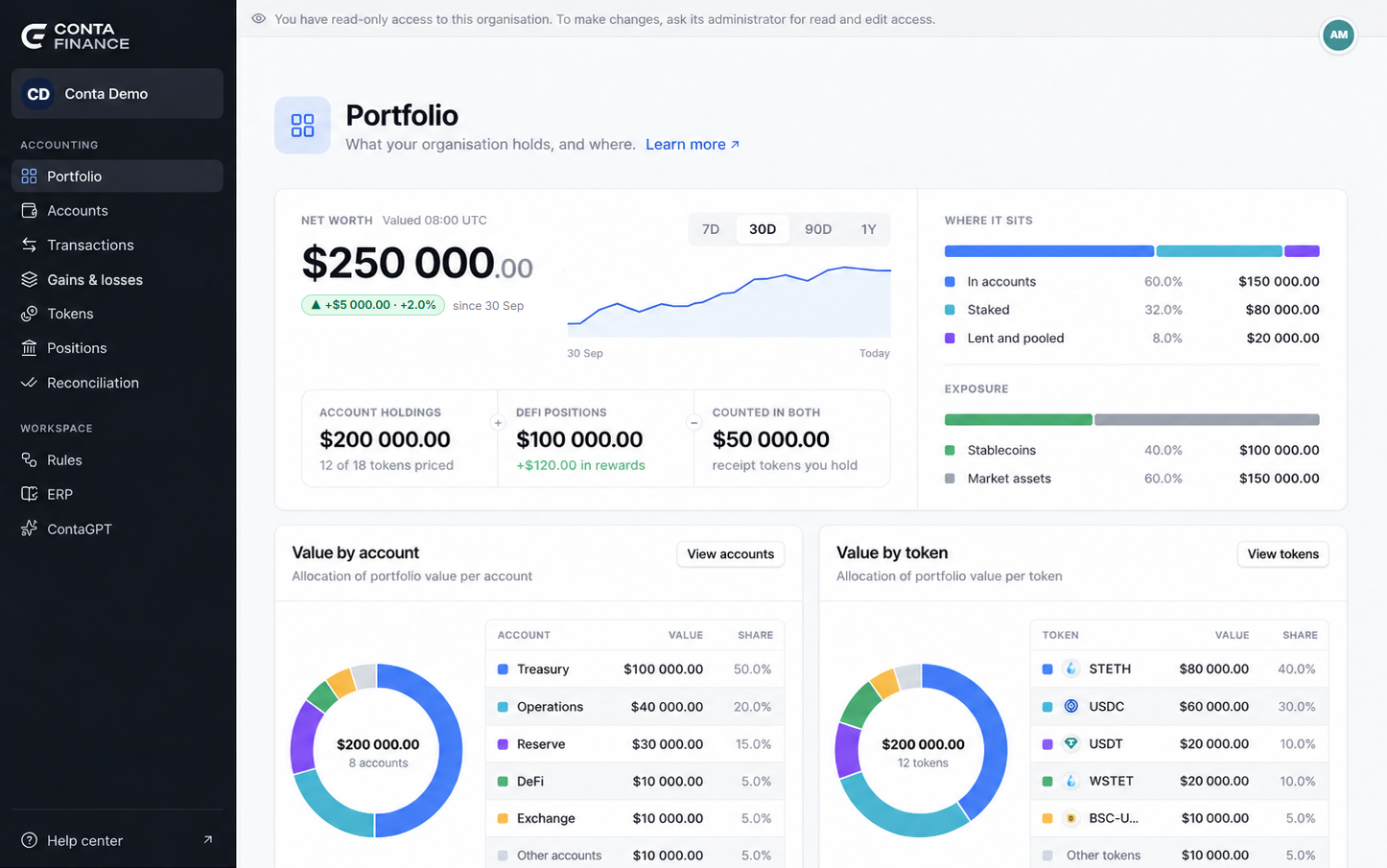
Conta centralizes activity from supported wallets and exchange accounts. The team can name counterparties, apply classification rules and investigate exceptions. Historical valuation and acquisition-cost calculations connect economic amounts to the underlying activity, subject to available price and source coverage.
Reconciliation helps identify balance differences. Exports support the handoff to the accounting system. Organization-specific access keeps teams working within the appropriate entity. These are operational capabilities that can support a control process, not a legal conclusion that the process satisfies MiCA.
Separate client assets from the company’s own books
Article 70 addresses safeguards for client crypto-assets and funds. Do not confuse that requirement with separating databases between Conta organizations. Technical tenant isolation and the legal safeguarding of client assets solve different problems.
For a custody business, distinguish company income, company assets and client positions before booking anything. A wallet balance does not identify its beneficial owner. Use the custody records and contracts to establish that relationship; do not infer it from a transaction’s address alone.
What a tool cannot complete for your compliance team
Conta Finance does not grant a license, determine your regulatory classification or replace required AML controls. It does not promise every service record, regulatory return or retention obligation is covered. Your compliance team must map these needs to the actual product, contracts and archive arrangements.
Before a demo, select a difficult transaction and ask to follow it from the source to the accounting output. Then list the evidence the product does not hold. This is a more useful evaluation than asking a vendor whether its software is simply “MiCA compliant”.
A control you can test
Choose one internal transfer. Check the source and destination accounts, the fee and the classification. Confirm that moving the company’s existing assets does not become revenue merely because both sides appear in the data.
Frequently asked questions
Does Conta Finance guarantee MiCA compliance?
No. It supports accounting records and review. Regulatory compliance depends on your activities, controls, governance and obligations. Assess the complete process with your legal and compliance teams.
Is a transaction hash sufficient evidence?
A hash identifies an on-chain transaction, but does not by itself establish ownership, business purpose, accounting treatment or all required client records. Keep the relevant context too.
Are MiCA and DORA the same requirement?
No. MiCA concerns crypto-asset market activities. DORA addresses digital operational resilience. Read our separate DORA guide for the supplier and continuity discussion.
Information checked on October 13, 2026. This is an operational guide, not legal advice. Conta Finance does not guarantee regulatory compliance. Confirm applicable rules and technical standards with qualified counsel.